Duncan'S Syndrome
UMLS: C0024314
Basic Information
Severity Level:
Critical
Definition:
Disorders characterized by proliferation of lymphoid tissue, general or unspecified.
UMLS ID:
C0024314
MeSH ID:
Synonyms:
Duncan'S Syndrome
Lymphoproliferative Disorder
Lymphoproliferative Disease
Lymphoproliferative Disease Nos
Lymphoproliferative Disease, Nos
Lymphoproliferative Disease, No Icd-O Subtype
Lymphoproliferative Disease, No International Classification Of Diseases For Oncology Subtype
Lymphoproliferative Disorder
Lymphoproliferative Disorder, Nos
Lymphoproliferative Disorders
Disease (Or Disorder); Lymphoproliferative
Diseases Lymphoproliferative
Disorders Lymphoproliferative
Duncan Syndrome
Duncan'S Syndrome
Duncans Syndrome
Lymphoproliferative Disease
Classification Hierarchy
MeSH Tree Number breakdown for C0024314
C15
Hemic and Lymphatic Diseases
C15.604
Lymphatic Diseases
C15.604.515
Lymphoproliferative Disorders
C20
Immune System Diseases
C20.683
Immunoproliferative Disorders
C20.683.515
Lymphoproliferative Disorders
ADE Molecular Mechanism Mapping
Drug-ADE-Human Protein Triplets
Molecular mechanism triplets showing drug-adverse event-protein relationships
5
Total Triplets
0
High Confidence
Loading Drug-ADE-Protein triplets...
Personalized Drug-Protein-ADE Network
Comprehensive Information for Personalized ADE
Comprehensive Information and Reliability for Drug-ADE Association
Drug Confidence Filter
DTA Confidence Level
Layout Style
Show Labels
Total Drugs
204
7 High |
24 Medium |
173 Low Confidence
Total Proteins
4
Target proteins associated with this ADE
Drug-Protein-ADE association
298
0 Known |
0 High |
5 Middle |
293 Low Confidence
Confidence Profile
2%
Known/High/Middle-confidence interactions
This interactive network visualization shows the relationships between the top 50 drugs (ranked by case number) out of 204 total drugs associated with this adverse event, their known and potential off-target proteins, and the associated adverse effect. The connections indicate binding interactions and mechanistic pathways.
Adverse Drug Event (ADE)
Drug
Protein
Drug-Center
Human Protein-Center
confidence level
Drug Confidence Level Distribution
Drug Type Distribution
Loading ADE information...
Pharmacological Target Class Distribution
Top 8 Function Target Sub Classes
Loading target information...
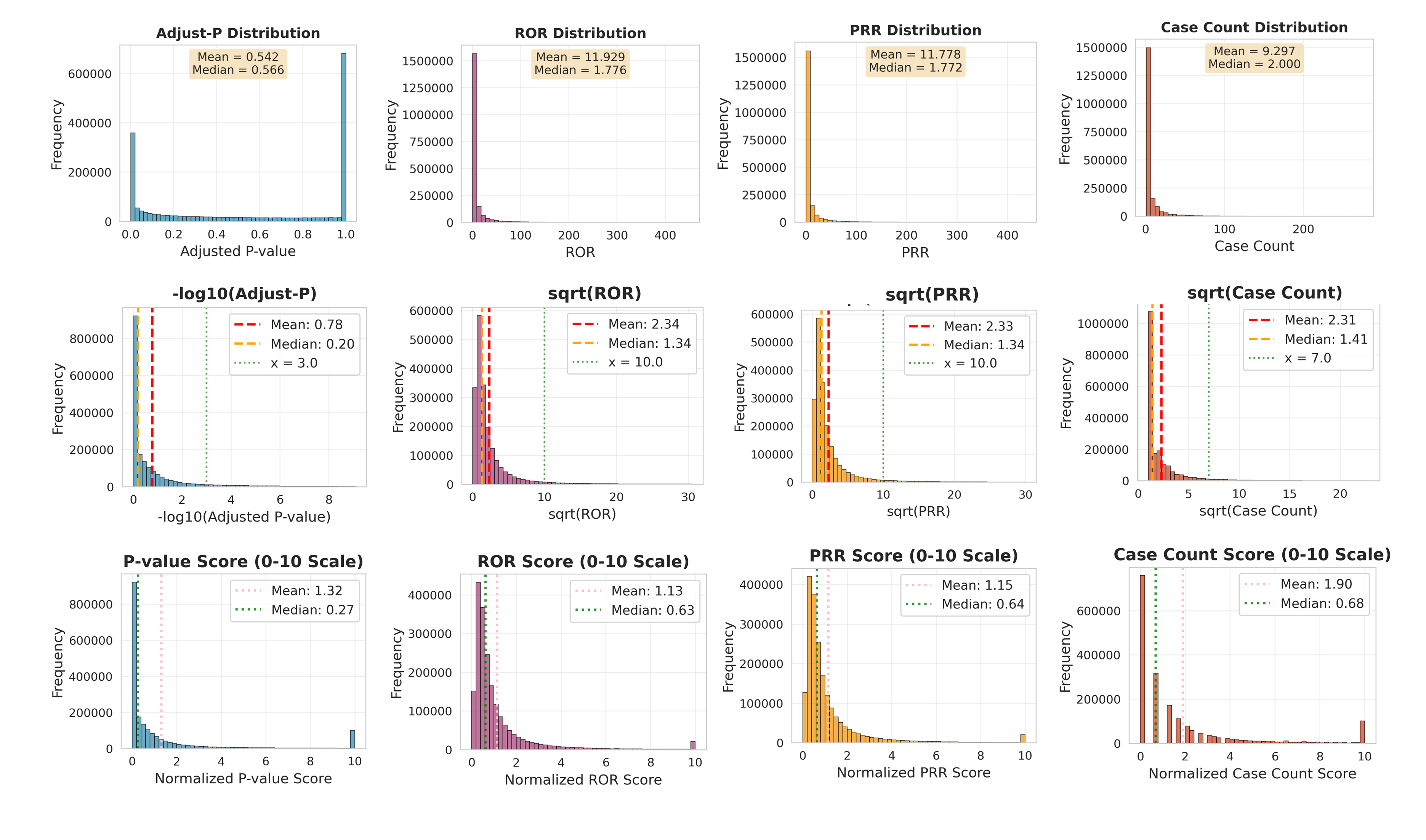
The Introduction of Drug-AE Confidence Score Grade
| Priority Level | Score Range | Description | Evidence Characteristics |
|---|---|---|---|
| High | Score ≥ 6.67High-priority associations requiring immediate attention. | Strong evidence across multiple dimensions with high statistical significance, robust association measures, and substantial case numbers. Warrant priority pharmacovigilance action. | High P-value scores (significant Adjust-P), Strong ROR/PRR values, Substantial case numbers, Complete dimensional coverage, Minimal data filtering needed. |
| Medium | 3.33 ≤ Score < 6.67Medium-priority associations requiring careful evaluation. | Moderate evidence quality with acceptable statistical significance and association strength. May need additional validation or monitoring before definitive action. | Moderate P-value significance, Reasonable ROR/PRR measures, Adequate case numbers, Partial dimensional coverage, Some data quality considerations. |
| Low | Score < 3.33Low-priority associations with limited evidence strength. | May represent weak signals, insufficient data, or associations requiring extensive additional investigation before any regulatory or clinical consideration. | Weak P-value significance, Low association measures, Limited case numbers, Incomplete dimensional data, Significant data filtering applied. |
The Introduction of Drug-AE Severity Score Grade
| Severity Level | Score Range | Description | Typical outcomes |
|---|---|---|---|
| Minimal | 0 ≤ Score ≤ 0.387 Low severity ADRs requiring minimal intervention. | Events that need medical attention to prevent permanent damage but without hospitalization or life-threatening consequences. | Primarily RI (Required Intervention) outcomes, Outpatient management, Preventive measures, Early intervention prevents escalation. |
| Mild | 0.387 < Score ≤ 0.861 Mild severity events requiring hospitalization. | Mix of intervention-required and hospitalization cases with manageable clinical outcomes and good recovery potential. | Mix of RI and HO outcomes, Initial or prolonged hospitalization, Active medical management, Generally favorable prognosis. |
| Moderate | 0.861 < Score ≤ 1.500 Moderate ADRs resulting in permanent disability. | Higher proportion of hospitalization and disability cases requiring intensive medical management and long-term care planning. | Increased HO and DS outcomes, Permanent disability, Extended hospitalization, Rehabilitation required, Long-term functional impairment. |
| Severe | 1.500 < Score ≤ 2.52High severity life-threatening events with significant morbidity. | Notable presence of disability and life-threatening outcomes requiring emergency intervention and intensive care management. | Prominent DS and LT outcomes, Life-threatening events, Emergency intervention required, ICU admission, High risk of permanent consequences. | Critical | 2.524 < Score ≤ 5.000Critical life-threatening or fatal ADRs with maximum clinical impact. | High proportion of life-threatening events and deaths with very strong drug-event associations requiring immediate regulatory action. | Significant LT and DE outcomes, Fatal events, Emergency life-support measures, Immediate drug discontinuation, Regulatory safety alerts. |
The Introduction of Drug-AE-Protein Confidence Score Grade
| Confidence Level | Relationships | Description | Evidence Types |
|---|---|---|---|
| Known/Valid | Direct DTA relationships | The drug-ADE, drug-target, and target-ADE associations are all derived from the same literature source. | Experimental validation, Clinical evidence |
| High | DT + TA + DA | Two of the three associations (drug-ADE, drug-target, and target-ADE) are derived from the same literature source, while the third is validated by other literature. | Multiple corroborating sources |
| Medium | DT + TA + DA | Two of the three associations (drug-ADE, drug-target, and target-ADE) are validated by separate literature sources. | Partial evidence chain |
| Low | TA + DT | Only target-ADE and drug-target associations are validated by literature sources. | Associative evidence only |
Personalized ADE
Route and Formulation-specified Associations
Pharmaceutic Granularity for Route and Formulation specification
Administration Routes (Total: 479 cases across 8 routes)
Dosage Forms (Total: 227 cases across 8 forms)
Drug Route Analysis
Drug Form Analysis
Drug Route Analysis
| Route | Drug Name | Case Number | Confidence Score | Confidence Level | Severity Score | Severity Level | Details | ||
|---|---|---|---|---|---|---|---|---|---|
| Loading data... | |||||||||
Drug Form Analysis
| Form | Drug Name | Case Number | Confidence Score | Confidence Level | Severity Score | Severity Level | Details | ||
|---|---|---|---|---|---|---|---|---|---|
| Loading data... | |||||||||
Disease-stratified Associations
Personalized Granularity for Disease and Indication Stratification
|
Indication Name
|
Drug Name
|
Case Number
|
Confidence Score
|
Confidence Level
|
Severity Score
|
Severity Level
|
Details |
|---|
DEV TOOL